
Rapid manufacturing has already reshaped the way industries develop, prototype, and scale production. With CNC machining ensuring precision, 3D printing offering unparalleled design flexibility, and Artificial Intelligence (AI) optimizing workflows, the future of manufacturing is moving toward integrated, intelligent ecosystems. This convergence is not only shortening product development cycles but also redefining quality, cost-efficiency, and customization in manufacturing.
The Role of CNC in Rapid Manufacturing
CNC (Computer Numerical Control) machining remains the backbone of high-precision parts.
- Tolerances: CNC machining achieves micrometer-level tolerances critical in aerospace, medical devices, and automotive industries.
- Material Compatibility: CNC works with a wide range of metals and plastics, providing structural reliability for end-use parts.
- Scalability: CNC is well-suited for both prototyping and mass production, especially when part durability is non-negotiable.
The Role of 3D Printing in Rapid Manufacturing
3D printing complements CNC by offering design freedom and agility.
- Complex Geometries: Additive manufacturing allows the production of lightweight lattice structures and internal channels that traditional methods cannot achieve.
- Rapid Prototyping: Iterations can be produced in hours rather than weeks, accelerating product development cycles.
- Material Innovation: Advances in polymers, composites, and metal powders extend 3D printing into industrial-grade production.
The Role of AI in Rapid Manufacturing
AI introduces intelligence into the manufacturing chain.
- Predictive Maintenance: AI algorithms monitor CNC and 3D printers to predict failures before they happen, minimizing downtime.
- Automated Design Optimization: Generative design powered by AI identifies optimal geometries based on strength, weight, and cost parameters.
- Smart Process Control: AI dynamically adjusts machining or printing parameters to ensure consistent quality across batches.
Synergy: AI + CNC + 3D Printing
When combined, these three technologies create a digitally integrated manufacturing environment:
- Design Phase: AI-powered generative design creates optimized 3D models.
- Prototyping Phase: 3D printing produces rapid prototypes for testing and validation.
- Production Phase: CNC machining ensures final parts meet high precision and durability standards.
- Continuous Improvement: AI analyzes production data to refine processes and reduce waste.
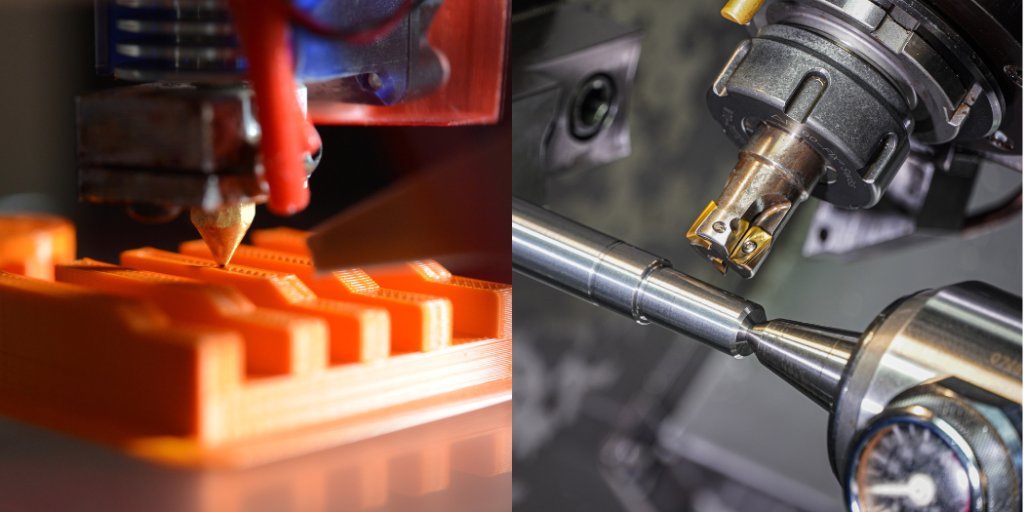
Comparative Analysis: CNC vs. 3D Printing vs. AI-Driven Integration
| Aspect | CNC Machining | 3D Printing | AI-Enhanced Integration |
|---|---|---|---|
| Precision | ±0.005 mm | ±0.1 mm (depending on process) | AI ensures process calibration across both |
| Material Range | Metals, plastics, composites | Polymers, resins, metal powders | AI recommends best-fit material for function |
| Design Complexity | Limited by tooling | High — complex geometries possible | AI generates optimized lightweight designs |
| Speed of Iteration | Medium | High (hours/days) | Highest (real-time AI optimization) |
| Cost Efficiency | Economical for scaling | Economical for prototyping | AI minimizes waste and cycle time |
| Best Use Case | End-use, high precision parts | Rapid prototyping, custom parts | Holistic optimization, hybrid workflows |
Industry Applications of AI-Driven Rapid Manufacturing
- Medical Devices: AI-optimized 3D printed implants with CNC finishing ensure biocompatibility and precision.
- Aerospace: Lightweight lattice structures 3D printed, then CNC-machined for final fit, with AI ensuring structural integrity.
- Automotive: AI-powered part design for electric vehicle components, balancing weight reduction with strength.
- Consumer Electronics: AI-driven design for compact housings, rapid prototyping via 3D printing, CNC machining for durability.
Conclusion
The future of rapid manufacturing is collaborative and intelligent. CNC machining, 3D printing, and AI are not competing technologies; instead, they are complementary pillars of the next industrial revolution. Companies that integrate these technologies will benefit from:
- Faster time-to-market
- Reduced production costs
- Enhanced product quality and reliability
As AI continues to evolve, expect to see self-optimizing factories, where every design, prototype, and final product is enhanced by data-driven intelligence.
What We Offer at Ze-tech Mold
At Ze-tech Mold, we provide end-to-end manufacturing services, including:
- CNC Machining & Turning
- 3D printing prototype
- sheet metal fabrication
- silicone vacuum casting
- Rapid Injection molding
- surface treatments
- PCB & PCBA
Whether you’re looking for precision CNC parts or custom prototypes, we provide tailored solutions for both low-volume and large-scale production. Get in touch with us today to discuss your project and see how we can bring your ideas to life.